

Whether you’re a pianist, string player, or play an instrument of any other kind, you know how it can be really difficult sometimes to get the two sides of your body to cooperate?
For me, this often manifested as “smudging” or “blurring” of notes in fast passages with string crossings. Where because my left hand and right hand weren’t quite in sync, things didn’t sound as clean and crisp as they should.
But one summer, I received a practice tip that magically made this no longer an issue.
Apparently, Isaac Stern used to practice passages like this by fingering the passage in both hands, simultaneously, while playing. (Violinist Catherine Cho describes this as well ~15:45 into her podcast episode)
The idea, was that practicing something on your non-dominant side would somehow lead to enhanced performance on the dominant side of your body too. Which sounds a little bonkers. But it seemed to work for me, and Isaac Stern certainly felt that it was a useful strategy.
So is there really something to this?
What does research say?
Well, there’s a fair amount of research on a phenomenon known as “bilateral transfer of learning” which suggests that training one side of your body can have benefits for the corresponding muscles on the other side of your body.
Let’s say, for instance, that you dislocated your shoulder and have to keep your left arm in a sling for a few weeks. Normally, after three weeks of keeping your arm immobilized, you’d expect to see some muscle atrophy and a loss of strength.
But it turns out there may be a way to maintain the strength and muscle mass of your injured arm – even if you can’t move it!
A study!
In a 2012 Australian study (Pearce et al.), two groups of participants were asked to keep their non-dominant arm in a sling for three weeks. One group did nothing at all during this time, but another group was asked to do a simple set of bicep exercises with their free arm, three times a week for the duration of the study.
After the three weeks were up, the researchers compared the muscle mass and strength of the participants’ immobilized arm with their initial baseline measurements taken before the study.
And was there any difference between the two groups?
Results
There was a pretty substantial difference!
The left-arm 1-rep max bicep curl for the no-exercise group decreased 3kg – from 15.1kg to 12.1kg. Meanwhile, the group that did bicep exercises with their right arm, maintained the strength in their immobilized left arm, going from 18kg at the start of the study to 17.9kg at the end of the study!
The muscle thickness in the elbow flexors of the no-exercise group also decreased 1.5mm – from 25.1mm to 23.6mm, while the exercise group saw no change, with a measurement of 23.6mm at both the beginning and the end of the study.
So that’s pretty cool – and when it comes to injuries, studies like this one suggest that we should continue to train the uninjured side of our body to minimize loss of strength and muscle on the injured side.
But going back to the original question, is it really worth spending some of our practice time training the muscles on our non-dominant side to do things they’ll never have to do? I mean, we only have so much time and energy, so would this kind of practice enhance performance on our dominant side, above and beyond what we could gain from practicing like normal?
Another study!
A team of Polish researchers (Witkowski et al., 2018) recruited 16 adolescent fencers (all right-handed) with an average of six years of experience.
Everyone started off with a series of tests on an electronic target, which evaluated their skill level on a basic fencing technique – the straight thrust.
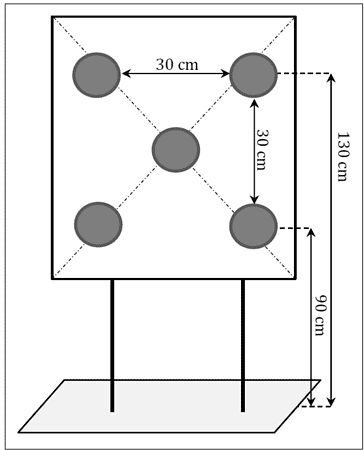
The first test involved hitting two random targets that would light up one after another. (i.e. target A would light up, the participant would have to hit it, and if they hit it successfully, target B would light up, and then they’d have to hit that.)
The second test involved hitting three random targets that would light up one after another (this was the most challenging of the three tests).
The third test also involved hitting three random targets – but in this test, all three targets lit up simultaneously, instead of one at a time.
The goal in each test was to be as accurate as possible, as fast as possible.
Six weeks of training
Next, participants were randomly assigned to one of two groups.
For the next six weeks, the control group followed their regular training routine. Meanwhile, the experimental group spent 30 minutes training their non-dominant side (left hand) instead, before rejoining the control group to complete their normal training activities.
Specifically, the experimental group spent two weeks working on whole-body coordination exercises on both the right and left sides, doing each drill three times on their non-dominant side, for every repetition on their dominant side.
Then, they spent two weeks doing eye-to-hand and eye-to-foot coordination drills using fencing foils and the electronic target, again with a 3-to-1 ratio.
And for the last two weeks, they not only repeated the drills and exercises from the first four weeks, but also practiced lunges, parries, and other techniques with the same 3-to-1 ratio.
Finally, participants in both groups were tested once again to see how much they improved.
So…which kind of training led to the greatest improvement? Was it worth taking time out of their regular training to work on their left (non-dominant) side? Even though they would never use those skills in competition?
Results
On the first test with the two random targets, both groups improved over the course of the six weeks. The control group improved by .17 seconds, and the experimental group improved by .37 seconds. A difference that was not statistically significant. So basically, the two groups improved by about the same amount.
Both groups improved on the third test as well, with the control group improving by .22 seconds and the experimental group improving by .27 seconds. This was the easier three-target test where the targets lit up simultaneously. And here too, there was no statistically significant difference between the two groups’ improvement in performance.
But when it came to the most challenging of the three tests – the three-target test where three random lights flashed one at a time – the difference in training became more evident. While both groups improved on this task as well, the group that trained both their left and right sides improved by .65 seconds, while the group that only trained their right side improved by just .24 seconds. In other words, the experimental group’s improvement was about 171% greater than the control group’s improvement – a difference that was statistically significant.
So why does this opposite-side practice help?
Why?
Well, it’s not entirely clear quite yet, as multiple theories have been proposed to explain the underlying mechanisms of bilateral transfer of learning (Ruddy & Carson, 2013).
For instance, the bilateral access model suggests that the brain forms neural representations (or “motor engrams”) of the skill. And that these are either established in parts of the brain that are responsible for both sides of the body, or even if they’re located in one hemisphere, can be shared or transferred to the opposite hemisphere.
Meanwhile, the cross-activation model suggests that when you practice a skill on one side of your body, there’s a bit of “neural spillover,” where your brain also experiences a bit of activity in the hemisphere that controls the side that you’re not training in that moment. So at the end of the day, both sides of your brain benefit – the part that controls your non-dominant side, as well as the part that controls your dominant side.
So what are we to do with this?
Takeaways
Well, this remains an ongoing area of research, and there are various nuances involved (e.g. like how transfer works better in some directions than others for certain tasks, and how there may be differences between tasks involving strength vs. timing). But all in all, it seems that Isaac Stern was onto something with his bilateral fingering exercise, and it may be worth experimenting with using your non-dominant hand more often to supplement your practice!
What might that look like?
It could be something like fingering with the opposite hand while solféging to enhance learning of new repertoire, as Kristian Steenstrup describes in his podcast episode (near the end of the episode).
Or training your left hand to engage in more challenging repertoire, while your right arm remains stuck in a cast. Or playing the same thing mirrored in both hands, as pianist Marc-André Hamelin demonstrates in this video (thanks, Timothy!).
Or playing a bit of table tennis with your non-dominant hand, or throwing darts with your opposite side, or putting a golf ball or shooting a basketball left-handed, or drilling new BJJ techniques on your non-dominant as well as dominant side, etc., etc.
At the end of the day, not only could this really benefit your playing, but it makes for a really engaging challenge in the practice room too! 😁
If you already do something like this, I’d love to hear about it in the comments below – and please share what instrument you play too, so we can get a sense of how you’ve tweaked and adjusted this concept to fit the demands of your instrument!
References
Pearce, A. J., Hendy, A., Bowen, W. A., & Kidgell, D. J. (2012). Corticospinal adaptations and strength maintenance in the immobilized arm following 3 weeks unilateral strength training. Scandinavian Journal of Medicine and Science in Sports, 23(6), 740–748. https://doi.org/10.1111/j.1600-0838.2012.01453.x
Ruddy, K. L., & Carson, R. G. (2013). Neural pathways mediating cross education of motor function. Frontiers in Human Neuroscience, 7. https://doi.org/10.3389/fnhum.2013.00397
Witkowski, M., Bronikowski, M., Nowik, A., Tomczak, M., Strugarek, J., & Króliczak, G. (2018). Evaluation of the effectiveness of a transfer (interhemispheric) training program in the early stages of fencing training. The Journal of Sports Medicine and Physical Fitness, 58(9). https://doi.org/10.23736/s0022-4707.17.07556-9


Regarding the fencing results, I immediately wanted to know if the three tests were jointly significant. I would also note that n=16 is very small for standard test results to be very reliable except under stringent assumptions. Still, interesting stuff, as my left arm is currently in a sling from an upper arm fracture. This is impeding my oboe work.
Sorry to hear about your injury, David! I take it this maybe makes reed work more difficult as well?
I’m guessing that the authors looked at each test separately, as each varied in level of difficulty. Given that the amount of improvement between groups was relatively similar in tests 1 and 3 (i.e. the tasks may not have been challenging enough to really differentiate between the benefits of bilateral training to be apparent), I’d imagine that the results of the three tests combined would dilute the difference between groups in test 2 and probably not yield statistically significant results.
To be fair, the authors acknowledge the small sample size as well.
There are some other studies looking at bilateral transfer in soccer, long jump, and a whole range of upper limb tasks in the lab, but I wonder if the rehab-related studies like the 2012 Pearce et al. one might be of more interest at the moment…
I’m a cornet / trumpet player and my teacher taught me the “trick” of trying to play an awkward phrase fingering with the left hand. Nice to see there’s some science behind it
Thanks, David – that’s exactly the sort of thing Kristian Steenstrup has his students do when learning new rep as well!
I am a musician but apply these techniques to figure skating. Most of my skating students rotate the other direction (counterclockwise, whereas I rotate clockwise) in the sport. I have had to learn most skating elements going “the other way,” and it has improved my technique going the “normal” way. My coaches have told me that often times my elements going the “other way” is actually better than my normal direction!
The bilateral practice is definitely useful in skating but I have yet to try it on my primary instrument.
Thanks for sharing, Eva! Very cool. Had no idea there was a normal and “other” way in figure skating. Totally makes sense!
The pianist Marc-André Hamelin uses a technique based on symmetrical fingerings for right and left hand on the piano, i.e. so that the fingers on each hand play exactly the same intervals in different directions. That technique works absolute marvels for difficult passages in either hand. There is a video on YouTube about it – mindblowing!
Thanks for the heads-up Timothy! That’s awesome. I wasn’t sure how exactly to apply this to the piano, as I couldn’t figure out how to make sure the two hands could do the same thing, but that video and the “line of symmetry” explained it all! Will post that above to help clarify for pianists. =)
Thanks Noa, being a violinist can you explain (or point to a resource) on exactly how you practice right hand fingering on a stringed instrument please? I am intrigued to try this.
Hi Kaylene – Catherine Cho and I chat about the bilateral fingering exercise in her podcast episode around 15:45 or so into it: https://bulletproofmusician.com/catherine-cho-on-developing-great-rhythm-and-why-old-school-metronomes-are-the-way-to-go/
The gist, is that it involves fingering simultaneously in both your right and left hands while playing (you don’t have to lift the fingers of your right hand up off of the bow necessarily, but just feel a tiny bit of pressure with each finger as you play, and eventually just imagine the fingers moving as you play so that it doesn’t disrupt what you’re doing with the bow arm).
Another way to do this would be to listen to a recording or imagine the sound of a tricky passage in your mind, while fingering on your leg or arm (or on a table or in the air) with your right hand.
I’d imagine there must be a video of something like this online, but I’m not aware of anything offhand. But do let me know if you come across anything!
This is something that I have been doing for years. It works particularly well with the trumpet because it is not that difficult to play a right-handed trumpet with the left hand. The best results are obtained when the tricky passage is played very slowly, and with many repetitions with the left hand. And I should mention that it is not necessary to physically play the instrument, doing just the fingering is sufficient. When the player goes back to playing the passage with the right hand, it is significantly better. It can be a quick fix, but it often needs to be done two or three days in a row in order to get the maximum benefit. I have shared this with colleagues and students, and they end up thanking me for it! It seems to me I first read about this in an étude book by jazz trumpet player John McNeil.
Thanks for the additional reference, Greg!
Great post, Noa, thanks for this! The Marc-André Hamelin symmetric inversion that Timothy mentions is fantastically helpful. I find it even helps when you have tricky passages as short as three notes, like an awkward finger crossing or leap. It can also help with really understanding chord spacing. (Like, some chords in Debussy, for example, just have a super awkward/non-intuitive spacing, and playing with the other hand in inversion helps you grasp the pattern more clearly.) It takes a lot of brain power (be sure you’ve had enough sleep before you try it) but it’s worth it for passages that stubbornly resist improvement. I also find it helpful to play RH passages as written with the LH (and vice-versa). In almost all cases, I find that my non-dominant hand can teach my dominant hand something about the passage. Another related-but-not-quite-the-same thing is when you have the hands playing parallel passages (like happens frequently in the Schubert Trout quintet, for example). Normally the upper voice (RH) is the line you want to be dominant. But I find practicing with the lower voice (LH) dominant not only makes the LH stronger, it also makes things easier and more fluid for my RH. I suppose this is a bit akin to vocal duets—the upper voice always has an easier time if the lower voice provides strong support. Anyway, a very interesting topic!
Thanks for the additional examples/applications, Jeffrey!
I play handbells and direct a handbell choir. When I am teaching the handbell stroke to someone who has not played before, I always have them learn a proper ringing stroke with their non-dominant hand. Ironically, I was just doing that this morning, and while I admitted I didn’t know the research behind it, it made sense to me and the person I was teaching. I also witnessed it in action, as once the person was successful ringing with their non-dominant hand, they switched to their dominant hand, and their ringing stroke was exactly right immediately.
Ah, very cool. Thanks for sharing, Carlene!
Wow! That’s freaky. I just tried it on the bassoon a little bit and it made a huge difference. I didn’t know if it was best to keep my hands in the normal position, but away from the instrument and have the fingers do the opposite of what they are used to doing or just reverse the hands and play the fingerings as if normal. I decided that option 1 was too complicated, so I did option 2 and it worked unexpectedly well.
Since I have to take my instrument in for maintenance on Thursday, I know what I will be doing for the four days it is in the shop. Thanks.
Thanks for sharing, Diane! Yeah, I wasn’t sure how this would look on some wind instruments, but it sounds like your option 2 worked pretty well. =)
Reed work – Indeed, impossible at the moment. 🙁
I’m wondering if there is a way to apply this to non-symmetric instrumentalists.
I’m a classical guitarist and I was trying this without considering the musicality of the exercise (just as mentioned in the piano link) but the fact that my right hand has nails makes it impossible if not dangerous – as in breaking a nail – to obtain a decent sound at all!
Do you know of any workaround for this that doesn’t include cutting my nails?
Hi Luigi,
I wonder if it would work to approach this like the violin – where you would finger the passage simultaneously in both hands? In other words, don’t worry about producing a sound with your right hand, just play the passage like you would normally in your left hand, and finger along with your right without moving up/down the instrument, but just keeping your hand/arm in the same place you would if you were picking, but just fingering along. Does that make sense?
Seymour Bernstein has a series of exercises based on the symmetry of the piano keyboard that Hamelin describes in his video. They’re designed to help the pianist have a better internal propriaceptive map of the keyboard.
I read about them originally in the Piano Quarterly (now defunct) in early 2000’s. A google search turned up a reference that implied that Bernstein also talks about these exercises in his book “With Your Own Two Hands”.
They are very useful, and I use them in my teaching sometimes.
Great, thanks, Rebecca. Nice to know there’s another source to explore further!
The article is very interesting, and I read all the wonderful comments, but I wonder how it can applied in singing. All the other instruments use their hands, but off course in singing we use only the throat and breathing, all located inside the body…any ideas?
Hi Tami – yeah, that’s a toughie. I had a quick exchange with a singer on facebook, but we didn’t really come up with anything that would relate to singers. It’s really more a practice technique for asymmetric skills…sorry!
Hi Noa,
Very interesting article. As a trombonist, I do this very rarely, but I could see the value. Sorry, but all I could think of reading about the fencing study was this scene from “The Princess Bride”:
https://tenor.com/view/not-left-handed-gif-13945460414114735140
Ha, nice. I had forgotten about that scene!