


When my kids took music lessons, they often put off practicing until a day or two before their lesson, at which point they’d try to cram a week’s worth of practice into a single marathon practice session.
Their teachers said they’d rather see them practice a tiny bit every day – even for just 5 or 10 minutes – rather than practicing for an hour, once a week. And when I was a kid, my teachers told me the same thing.
I mean, daily practice certainly makes logical sense. But how important is it really?
Does it matter all that much, if the total weekly practice time adds up to the same amount?
A study!
A team of Brazilian researchers (Luz et al., 2022) recruited 90 university-age participants to take part in a juggling study, where the goal was to catch as many balls as possible in a row without a drop.
Before practicing, each participant watched an instructional video, where the instructor demonstrated the juggling task, and then walked the participant through a series of step-by-step instructions and gave them a few practice attempts.
Three practice groups
Then it was time for an initial pre-test, where participants had five chances to establish a baseline of their abilities.
After completing this test, it was time to practice. Everyone was randomly assigned to one of three practice groups:
- The massed group did 30 minutes of continuous practice.
- The distributed-within group did their 30 min of practice in six 5-minute chunks separated by 3-minute breaks.
- The distributed-between group spread out their 30 minutes of practice over three days – 10 minutes of practice per day.
A few more tests
As soon as participants were done with their training, they completed a post-test, to see how much they improved.
24 hours later, they performed one final test – a retention test – to see how much of their skills stuck.
And was there any difference in learning between the groups?
Results
Well, all three groups improved from the pre-test to the post-test. So does that mean our teachers were mistaken about the importance of daily practice?
Well, not so fast!
Because on the retention test that took place 24 hours after practicing, the group that spread out their practice over three days performed better than the two groups that did all of their practice in one single day.
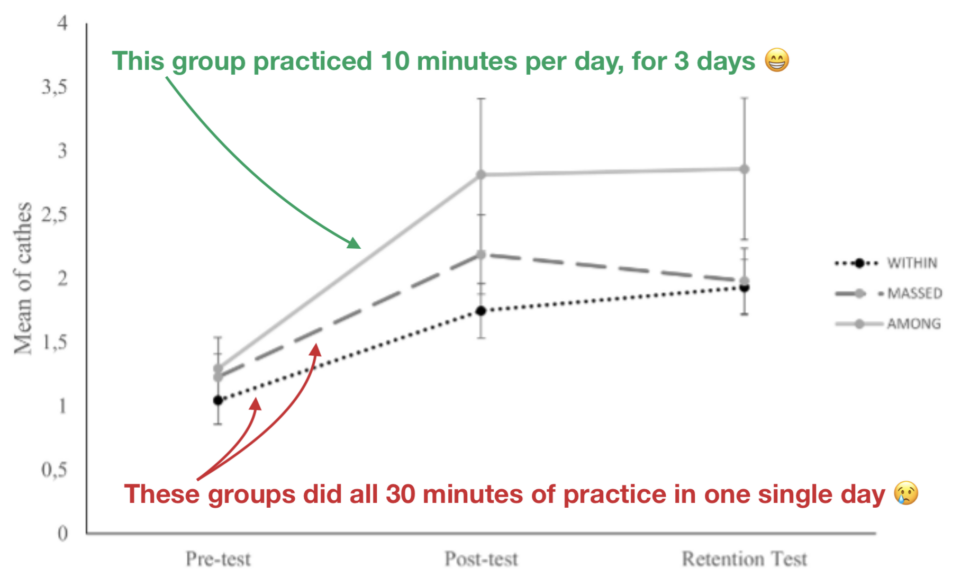
So it seems our teachers were on to something, after all. 😅
But wait – there’s more!
Because I came across another study which suggests that age may be another important factor. And that integrating little breaks into our practice sessions (like the distributed-within group did) may help improve our ability to learn effectively as we get older. 🤔
Another study!
In another Brazilian study (Leite et al., 2013), 32 participants were recruited to practice and perform a timing/coordination task.
Half of the participants were between ages 19-27, while the other half were between ages 62-74.
And everyone was required to practice the task until they could perform the task perfectly, three times in a row (where perfectly = less than 30ms error).
Younger vs older
However, half of the younger and older participants practiced the skill in a massed practice format. Which basically just meant doing one repetition after another, with only a 3-second pause between each repetition, and no real break until they reached the target level of performance.
Meanwhile, the other half of the younger and older participants engaged in distributed practice. Where they would do nine repetitions with a 3-sec pause between each, followed by a longer 40-second break, and then nine more repetitions, etc., until they could get those three perfect repetitions in a row.
A transfer test
20 minutes after completing their practice, participants were given a test to see how effectively they had learned this new skill.
This final test was basically the same timing/coordination task they had practiced, except the timing was changed a little bit, so they would have to adjust in the moment to a slightly new challenge.
And was there any difference in performance between the groups?
How long it took to reach the goal
Well, remember that we have four total groups – a younger massed practice group and a younger distributed practice group, and an older massed practice group and an older distributed practice group.
And for better or worse, the younger participants in both groups were able to get to the target level of performance faster, with fewer practice repetitions than the older participants.
It didn’t seem to matter if they had little breaks inserted into their practice or not. They learned faster than the older participants regardless. 🥲
Performance on the transfer test
Practice breaks didn’t seem to have much of an impact among the younger learners when it came to performance on the transfer task either.
However, these little practice breaks appeared to have a significant impact on the performance of the older participants!
When the older participants practiced with short 40-second breaks between blocks of nine repetitions (distributed practice), their test performance was similar to the younger groups.
But when the older participants just kept doing one repetition after another without a break (massed practice), their performance on the transfer test was significantly worse.
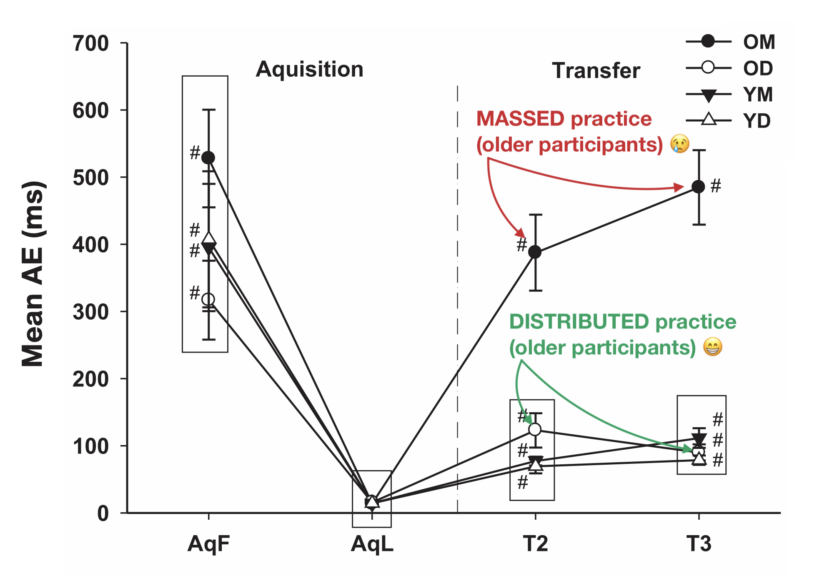
So why might distributed practice have benefits over massed practice?
Why?
There are a number of theories that have been proposed to explain this phenomenon.
For instance, part of it could be related to the “deficient processing hypothesis,” which suggests that our brain doesn’t process what we’re doing as deeply if we repeat things too quickly without a pause.
We also looked at a study on “neural replay” during pauses between sets of repetitions, which could be another factor.
And there’s also memory consolidation, where your brain is better able to process and organize what you’ve learned if there is some space between practice sessions, especially when you’re able to integrate some sleep into the mix (like in this study, or this one).
So what are we to take away from all of this?
Takeaways
Well, we don’t necessarily have to practice every single day, 365 days per year, of course. Because like athletes, it can be helpful to take breaks every so often.
But you’re probably going to improve more consistently, experience less frustration in the long run, and enjoy yourself more if you practice a tiny bit every day, rather than cramming the day before your lesson. Especially if you remember to sprinkle in some tiny microbreaks throughout your practice as well – particularly as you get older!
A book – and how you could shape it
This is one of the posts I plan to draw on for a book I’m considering. One aimed at addressing those oh-so-frustrating “but it sounded better at home” moments, with research-based guidance on how we can shrink the gap between how we sound in the practice room and how we sound on stage. The idea is short, focused chapters, each addressing a specific frustration, with concrete action steps.
The community is central to this project, as each chapter will close with real-world examples from students, teachers, and professional musicians – showing how the principle plays out in actual practice, performance, or teaching.
If you’ve applied any concepts from this post to your own practicing, performing, or teaching, and found them helpful, I’d love to hear your story. Like, how do you get your students to practice daily? Because getting started can often be the hardest thing, do you have any strategies or techniques that help make it easier for students (or even yourself) to start practicing? What are the little “pro tips” related to this that you’ve discovered over the years? 😁
A short note is totally fine! Because if your story seems like a good fit, I’d love to set up a short conversation to hear more.
👉 Click here to email me your story
📚 Click here to follow the project
Enter your email below to join the Bulletproof Musician newsletter for weekly practice hacks and updates. You’ll also get access to the free 7-day Pressure Proof course, where you’ll learn five essential practice strategies for making more progress in the practice room and playing more like yourself when it counts.
References
Leite, C.M., Ugrinowitsch, H., Carvalho, M.F., & Benda, R.N. (2013). Distribution of Practice Effects on Older and Younger Adults’ Motor-Skill Learning Ability. Human Movement, 14, 20-26.
Luz, J. E. M., Santos, H. D., & Bonuzzi, G. M. G. (2022). Effects of the different distributed practice regimes on the learning of three-ball cascade juggling task. Brazilian Journal of Motor Behavior, 16(2), 153–161. https://doi.org/10.20338/bjmb.v16i1.268


It is not important to practice EVERY day, just most days. From sport as you certainly are trained about, one stresses the organism or system, and allows a recovery and supercompensation to happen. And sometimes with no practice (usually because of external events) and no mental practice of any kind, one improves.
How do we know objectively: well because people with time off are often able to do things that they couldn’t do at all beforehand.
Practice is important. Frequency is important. But it is not th only thing.