

Legendary violin pedagogue Ivan Galamian once wrote that there are three essential tasks we must engage in during the learning and preparation of a piece for performance.
One, is “building” time, or the time we need to solve problems and technical issues in whatever we’re working on.
Another is “performance” time, where we practice playing a piece through as we want it to be on stage.
But first, there’s “interpreting” time, which involves taking the time to decide what we think the piece ought to sound like in the first place.
Of course, whenever I got a new piece, I was usually too excited to spend any time thinking about what it should sound like. I’d just dive right in and start playing, happily nerding out on the various technical challenges that I encountered as I worked through the piece.
Is that a reasonable way to approach new repertoire?
Or is really worth taking the time to do what Galamian recommended? To think a little more deeply about the music? And what we’re really aiming for, beyond the mechanics and execution of our instrument?
A study!
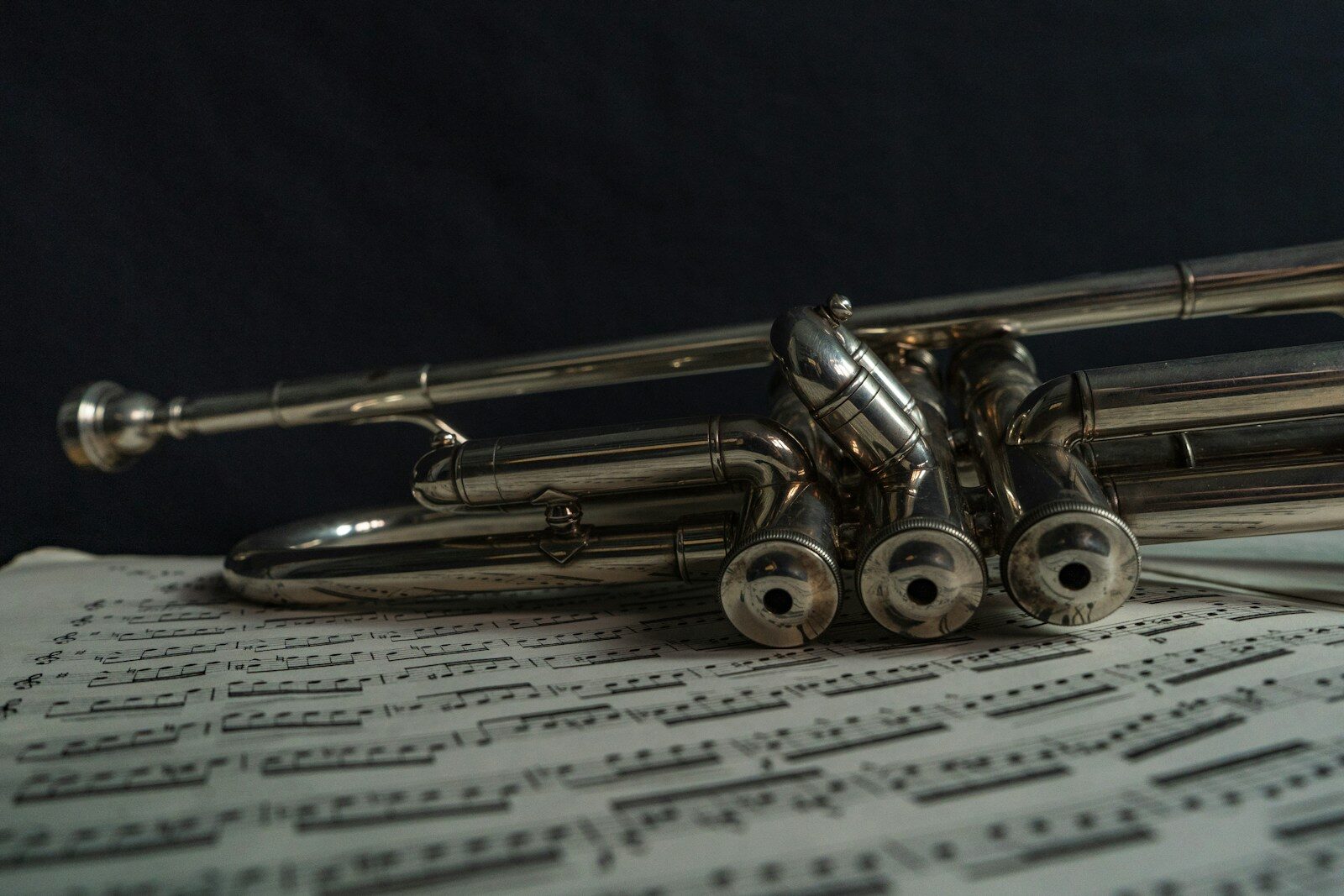
A team of researchers from the Netherlands (Williams et al., 2023) recruited seven trumpet players of varying ages (24-45) and experience levels (12-38 years) to learn and perform a set of Bach excerpts on the natural trumpet1.
In particular, they were curious to see how much of an impact a so-called “external” focus of attention might have on the learning process of new music.
And what’s an external focus?
An external focus means thinking more about the sound you want, or the phrasing, or the mood or emotion that you’re trying to express through the music. A clear musical intention, in other words. As opposed to an internal focus, where we focus on controlling the mechanics of playing – like our fingers, arm movements, air, posture, manipulations of the instrument, etc. (which we’ve looked at before here and here)

Regular practice
Everyone began by recording a baseline performance of four excerpts, and then spent three days practicing in their “normal” way. Which is to say, with most of their focus on managing technical details and approaching their practice session with more of an internal focus of attention.
To keep things fair, everyone was allowed three five-minute practice sessions per day to devote to these excerpts.
Then, they returned for a recording of the excerpts to see how much they had improved.
A different approach to practice
Eight weeks later, everyone returned to learn and record a new set of excerpts.
Once again, they started out by recording a baseline performance of these excerpts. Followed by three days of practicing, in three five-minute practice sessions per day.
But this time, they were asked to practice differently.
Instead of practicing as they normally might, participants were asked to use a 4-step process that involved developing clearer musical intentions about what they were playing (similar to the one Kristian Steenstrup describes in this podcast episode). Called the Audiation Practice Tool, here were the instructions (or download them here):
- Imagine the phrase you are about to play with as much nuance as you can evoke (e.g., pitch, tone quality, volume, articulation, transition from one note to another)
- Sing and gesture the phrase dramatically
- Play the phrase
- Play another version (or multiple versions) of the phrase by focusing on a clearly different emotion or character
Then, three days later, participants returned to record a final recording, to see how much they improved after using the Audiation Practice Tool method.
So…was there any difference in how much they improved after normal practice vs when they took time to more focus on their musical intention during each chunk of practice?
Results
Yes, there totally was!
For the most part, the participants did improve when using their normal approach to practice. Where they focused more on technique and the mechanics of playing the instrument. So it’s not like an internal focus of attention doesn’t work.
But when participants took the time to clarify a clear intention for the phrase, singing and gesturing the phrase expressively, they improved significantly more.
And when asked about their practice focus afterwards, participants did describe having more of an external focus after using the APT protocol. They said things like:
- “I was actively thinking about the way I really wanted it to sound”
- “APT encourages my sound imagination”
For what it’s worth, many also said they had more fun practicing with the APT protocol:
- “The practice sessions were never boring…how easy it was to focus”
- “It felt easy for the brain; it was always active and everything I practice feels fresh even though I am physically tired…I enjoyed this practicing process overall”
And, when the researchers followed up with the participants three months later, all of the participants reported continuing to use at least some part of the APT protocol. Which suggests that it made enough of an impression on them, that they were still using it even though nobody was asking them to.
So what can we take away from all of this?
Caveats
There are a number of meaningful takeaways, but also a couple limitations to keep in mind.
For one, performance in this study was evaluated on the basis of note accuracy alone and expressiveness was not part of the criteria. So we can’t say for sure from this study alone what sort of impact the audiation strategy might have on the overall quality or the expressiveness of one’s playing.
That said, this was completely intentional. The researchers wanted to avoid any ambiguity in evaluating participants’ performances, so they chose the natural trumpet, an instrument that can be quite challenging, where imperfections in one’s playing are clearly audible even to the untrained ear.
Another thing to keep in mind, is that with just seven participants, the sample size was also quite small, and limited to a very specific instrument. That said, the results of this study are pretty consistent with much of the previous research in both music and sport. So I think we can feel reasonably confident in generalizing these findings to our own playing (and our students’), no matter the instrument.
Takeaways
When we’re in the early stages of learning a new piece, it’s really easy to fixate on technical accuracy and simply react to whatever sounds “bad” to our ears. To get preoccupied with controlling our fingers, hands, muscles, and mechanics, and cleaning up errors, than taking the time to form a clearer target to aim for.
But this study highlights how taking the time to clarify our musical intentions could be a big time saver in the end – even if it means doing fewer physical repetitions in the same amount of time. Which, actually, for instruments like the trumpet where too many repetitions can lead to fatigue and increased risk of injury, could be a nice bonus benefit of this approach to practicing!
A book – and how you could shape it
This is one of the posts I plan to draw on for a book I’m considering. One aimed at addressing those oh-so-frustrating “but it sounded better at home” moments, with research-based guidance on how we can shrink the gap between how we sound in the practice room and how we sound on stage. The idea is short, focused chapters, each addressing a specific frustration, with concrete action steps.
The community is central to this project, as each chapter will close with real-world examples from students, teachers, and professional musicians – showing how the principle plays out in actual practice, performance, or teaching.
If you’ve applied any concepts from this post to your own practicing, performing, or teaching, and found them helpful, I’d love to hear your story. Like, how do you cultivate clearer intentions in your own playing? Through singing? Listening to recordings? Score study? Other ways? How do you help students begin to do this? What are the little “pro tips” related to this that you’ve discovered over the years? 😁
A short note is totally fine! Because if your story seems like a good fit, I’d love to set up a short conversation to hear more.
👉 Click here to email me your story
📚 Click here to follow the project
Enter your email below to join the Bulletproof Musician newsletter for weekly practice hacks and updates. You’ll also get access to the free 7-day Pressure Proof course, where you’ll learn five essential practice strategies for making more progress in the practice room and playing more like yourself when it counts.
References
Williams, S. G., van Ketel, J. E., & Schaefer, R. S. (2023). Practicing Musical Intention: The Effects of External Focus of Attention on Musicians’ Skill Acquisition. Music & Science, 6. https://doi.org/10.1177/20592043231151416

