


Carolyn Christie: On Overcoming Nerves With Healthier Internal Dialogue – and Phrasing!
Do you remember the first time you experienced nerves in a performance or audition?
For me, it started pretty early – I can remember feeling butterflies and jitters and worrying about how things would go as early as 4 or 5. And some days certainly felt worse and more intense than others.
But for some, nerves aren’t really an issue until their teenage years. And sometimes not even until college, graduate school, or beyond.
Lucky ducky, you might be thinking to yourself. But what do you do if you’ve performed just fine all of your life, and then suddenly, 20 years into your career, you are slammed with worries, self-doubt, and a degree of anxiety that you’ve never had to deal with before? When the stakes are high and we no longer have the support and safety net that our school years provided us with?
That’s exactly what happened to my guest today. And in today’s episode, she’ll explain why she lost her confidence and how she overcame this challenge and grew stronger as a result.
Meet Carolyn Christie
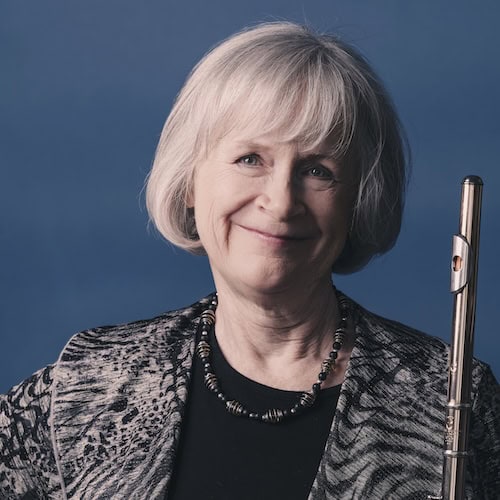
Flutist, educator, and performance coach Carolyn Christie was the second flutist of the Montreal Symphony for 36 years, during which time she toured with the orchestra 40 times, and can be heard on ~100 recordings.
Carolyn has also served on the faculties of multiple institutions, most recently McGill University. After retiring from the Montreal Symphony, she earned a Masters degree in human kinetics, and now works with students and professionals on the mental side of performing under pressure.
In today’s episode…
- 00:38 – Were nerves an issue during the audition process?
- 02:29 – Why did nerves suddenly become a problem?
- 07:09 – What did you discover about the role of mental preparation and self-talk?
- 09:50 – How Carolyn overcame overthinking by focusing on phrasing
- 18:35 – Important questions to ask when planning out your practice; plus, practice grids
- 24:42 – The difference in mindset between practicing and auditions and performances
- 27:21 – How do you get past the fear of negative evaluation in auditions?
- 28:31 – Approaching tenure with a growth mindset
- 32:19 – One way to be a better leader and cultivate trust in your section
- 34:05 – What does Carolyn mean by a “clinical” approach to practicing and evaluation?
- 39:05 – What role does singing play in learning?
[00:00:00] Carolyn CHRISTIE: What happened to me was I lost my confidence. I just started feeling a lot of the self- presentation worry about how other people were perceiving me. My inner dialogue was awful. I could not control the comparisons, the worry about the outcome while I was playing.
And it got worse and worse and worse and worse. And it was, it was terrifying because that's how I fed my family.
[00:00:38] Noa KAGEYAMA: So Carolyn, you had a long and distinguished career in the Montreal Symphony, winning the second flute job, I believe, at age 23.
But I read that your professional orchestra career actually began even earlier, as you won your first job at age 18, which made me wonder about something that I was having a conversation with recently with some of my students. So we were talking about nerves and how some folks have to deal with performance anxiety quite early on in their musical lives.
I remember getting nervous when I was probably five or six even, uh, whereas for others, yeah, you know, we experience butterflies, of course, but nerves in a serious way don't really hit them until later, maybe in college, sometimes grad school, even sometimes beyond that. And it's such an individual thing that I'm curious, you know, at 18, like what was your relationship like with nerves at that point in your career when you were taking auditions?
[00:01:30] Carolyn CHRISTIE: Well, I'll tell you a little bit about that first orchestra. And I want to mention some time during this discussion, the role of luck in a musician's life. I had so much darn luck in my life, I can't believe it. And in my second year undergraduate at McGill in Montreal, a position for second flute opened up in the Canada Symphony.
And I loved orchestra. I auditioned and I got it. And I didn't really have any, uh, problem with nerves at that point. And the same thing when I auditioned, uh, I guess my first year of grad school at NEC, an audition came up for the Edmonton Symphony, and I took that. Didn't have any nerves, but I was called the night before to do the audition the next day in another city.
So maybe I was just so distracted with getting from Boston to Toronto that, you know, took away the nerves. And then the Montreal Symphony audition, that audition I had no nerves for at all. But my bad stage fright came about 20 years into my career with the Montreal Symphony. So I could play, but I had absolutely no mental preparation whatsoever in case things kind of went off the rails.
[00:02:45] Noa KAGEYAMA: Can you tell me more about whether there was something that precipitated these nerves or like, you know, cause how is it that you managed to go through what for a lot of folks are quite stressful experiences. I mean, even jumping into an orchestra professionally at that age with presumably less experience across the range of repertoire and being an instrument where, you know, you're the only one playing second flute.
It's not like sitting in a violin or string section where you have a stand partner or other folks you can rely on at times
I'm curious how you managed to get through that point and if there was something that changed 20 years in that seemed to spark an experience that you hadn't had before.
[00:03:24] Carolyn CHRISTIE: Well, first off, I'll mention I had a couple of one offs with bad stage fright, like over the years, maybe five times. But again, my incredible luck when I joined the Montreal Symphony was my teacher, Jeanne Baxtresser, was playing first flute. So I felt like I just joined this very warm environment. I was so supported, and I knew I would get instruction that would be helpful to me.
So that was enormously lucky. But, uh, the Montreal Symphony, as my career progressed, and this is from 78, I'd say until about 1990, 95. I can't remember exactly. Uh, we were working like crazy people. We'd started recording, so despite a full schedule, most of our days off, two months of the year, we were recording.
And then two other months of the year, very often we go out on tour for up to four weeks. And I had, I was divorced with two children. So looking back, I think classic burnout. What happened to me was I lost my confidence. I just started feeling a lot of the self- presentation worry about how other people were perceiving me.
I joke that I played next to five of the gods of the flute on principal, including Ms. Baxtresser, uh, Tim Hutchins, and Robert Langevin, who's in New York now, et cetera, et cetera. My inner dialogue was awful. I could not control the comparisons, the worry about the outcome while I was playing.
And it got worse and worse and worse and worse. And, uh, back then, um, I, I, you know, I've never asked my colleagues, but I knew nothing about performance psychology, sport psychology, never heard about Don Greene or later you. I knew nothing about this. Nobody talked about stage fright. And I think as a woman in '78 joining a big orchestra, I feel a little bit of pressure, but it's more the women who were 10 years before me who had to bear the brunt. But, um, we had no, no one to talk to. And it was, it was terrifying because that's how I fed my family. I don't know how long it took because I wasn't thinking of keeping score back then, but when I look back now with my training, I know it was my self talk that was the major thing that I improved. One of my nieces Sommer Christie is now a certified mental performance consultant. She has a doctorate now and she had been a Canadian rugby star. Team Canada. It wasn't an Olympic sport when she was playing. Anyway, she was doing a master's in human kinetics to learn how to be a mental performance consultant.
So this was a couple of years after I got my act together and I was playing better again. And I brought her to McGill to speak to my flute players. And two remarkable things happened. I didn't advertise this little talk, it was just for my flute class, and the room was jammed. And there were even professors there, and I, first time I thought maybe it wasn't just me, honestly and truly.
And then when Summer was giving her workshop as part of her internship, I realized she was teaching skills that took me 30 years to learn. Self talk, being in the zone, uh, confidence, motivation. I couldn't believe this stuff was taught. And that's what, um, lit my fire to get a master's degree in this counseling work when I retired.
[00:07:06] Noa KAGEYAMA: I wonder if we can take a look at a couple of those things in particular. You mentioned, uh, inner dialogue and self talk being something that, um, you started to become increasingly aware of at that time when you were struggling a little bit to play at the level that you knew you were capable of. Sometimes it's easy to think that we're the only ones who have that voice inside our head, um, to the degree of criticalness and abusiveness that sometimes it represents. Do you remember the sorts of things you used to say to yourself whether in the practice room or before you go on stage or even during a performance in rests or as you're playing?
[00:07:46] Carolyn CHRISTIE: I must say now I don't remember what I was thinking in the practice room. I do remember what I would think on stage. And, you know, when you play in an orchestra for 10, 20 years, you can think about something else, kind of, in the rests. I don't advise people to do this, but I was. And the classic for us second flute players is the New World Symphony, because there are lots of nice, lovely little second flute solos, but the first flute has already played them.
So again, these gods and goddesses would play the solo I was about to play. So it was the comparison thing and I would be thinking as I'm getting ready to play. I can't do this. Can I run off stage? They're going to compare me. The critics are going to hate me. Why am I here? And then I'd play and I'd kind of bark it out you know, they, I was never taken to task for it, but I knew it wasn't very good.
And the thing that I changed and with the research I've done now, maybe I wouldn't advise doing it exactly the same way. But what I did was it became a mantra for me to say, I can't wait to get to this solo. And I repeated it so many times became real for me, and then when the solo came, I could focus on actually playing the way I want to play.
I, it definitely wasn't honest. I, I could wait to get to the solo for sure, and I think if I advised a client now, I would say try to look for something honest, like I can play this solo, I've got it, or something like that, but that didn't occur to me back then.
[00:09:29] Noa KAGEYAMA: That kind of ties into the second element of what you were actually focusing on while playing the solo bits instead of worrying about how it was coming out or mentally maybe comparing it to what had just come before and so forth. Like, what did you find yourself actually starting to use up your cognitive bandwidth with as you were playing that was helpful.
[00:09:50] Carolyn CHRISTIE: When it got better, I could focus on the thing that was the most important to me and that was the phrasing. The sound and the phrasing. I could do the lifts I wanted to do, I could do the colors I wanted, I knew I could do. So I was hyper focusing on my phrasing. And that took, also took my mind off the concern because I was focusing on something I could actually control.
And you know what? I never learned until I did this studying and and I made a mistake with this right to the end of my career. It was overthinking. I didn't know about it. An example from the second flute world is the beginning of Firebird. The low strings start the tune, the second flute plays it.
It's not hard. But I would start to overthink where my little finger on my right hand was going. Classic. Uh, overthinking, but I didn't know and I would screw it up and I did it twice in a concert and you really can't do that when you're in a professional orchestra and then I just decided that I would try to go for the phrasing and as I said to the piccolo player, the curse has been broken because then I could play it again.
[00:11:00] Noa KAGEYAMA: I wonder if you can say more about the overthinking things, you know, for folks who, I think we've all experienced that, but for folks who don't understand why that's such an issue and why that tends to trip us up so much, can you maybe share a little bit about what you found?
[00:11:13] Carolyn CHRISTIE: Well, there are times when you have to overthink in an orchestra and that's if a conductor has changed something at the break, which did happen to us on more than one occasion with a certain conductor. But if there's a skill that you can do automatically, it's not helpful to think about the mechanics. I would do things with my little finger that I didn't have to do. I was over trying an automatic function.
[00:11:37] Noa KAGEYAMA: And so it sounds like by focusing on phrasing, and does it necessarily have to be phrasing or just in your particular role that was the thing that resonated most with you?
[00:11:45] Carolyn CHRISTIE: Yeah, with me, it was phrasing and sound. They were the things that were the most important to me, and I found that very helpful. Also, as a goal for a successful concert, if I phrased the way I wanted to, that was a success in my books, instead of get the outcome, like getting a good critique, or somebody liking it, you know, that kind of thing.
Something I could control, and it was phrasing that was important to me.
[00:12:14] Noa KAGEYAMA: And this is where I may struggle a bit not knowing too much about how to play the flute, but I wonder if you could elaborate a little bit on what you mean by phrasing in terms of, you know, because I think we all understand, conceptually, phrasing, but in terms of what it means for a flutist or even for a musician in general, like what exactly does focusing on phrasing mean and if it helps you can use a specific example perhaps of, you know, from note to note or moment to moment, what that might mean or look like.
[00:12:42] Carolyn CHRISTIE: That's a tough question. Phrasing for me is, um, The general line, whether it's one note, like the, there's one note, the second flute plays, the second movement of La Mer, gotta phrase that to go away. For us, it's using the air, using the tone, using the colors.
And I would be thinking about manipulating that or using that instead of the concern for things I couldn't, uh, couldn't control like the judgment.
[00:13:14] Noa KAGEYAMA: sounds like you're ensuring that whether it's through dynamics or color or sound, that there's some aspect of what you're doing in each moment that's changing, whether it's moving forwards or backwards or, um, and presumably, related in some way to what's happening around you and what it is that the conductor is also asking for in that moment.
[00:13:38] Carolyn CHRISTIE: Well, sometimes what the conductor is asking for. Uh, yeah, exactly. Because in an orchestra you're, you know, you're, you're always hearing the intonation, you're hearing the speed and the dynamics. It's the musical content that resonated with me. I've had clients who have, uh, rhythm resonate with them. Not so much for me.
Or driving the harmony, I've heard frequently for low instruments. Flutes never drive the harmony. So, but we do drive the phrase very often. So that worked for me. It's very individual.
[00:14:14] Noa KAGEYAMA: I'm just making assumptions, but I'm assuming that some of this understanding of what you need to be doing actively in each moment on stage perhaps started to affect what you did in the practice room and how you prepared for these moments?
[00:14:29] Carolyn CHRISTIE: You know, in my case it didn't because my preparation was really good. Looking back with more of a scholarly kind of eye. I just couldn't translate it to the stage because other stuff got in my head. Uh, but definitely if phrasing beautifully was, for example, one of my students goals, we would gear the practicing towards achieving that.
[00:14:54] Noa KAGEYAMA: Can I ask how one might practice that? So let's say you have a student who hasn't done that sort of preparation, and so if they tried to focus on phrasing in a concert, their mind would be sort of blank because it hadn't been mapped out or planned or thought of. How would you? Work with that student or have them practice that in advance.
[00:15:12] Carolyn CHRISTIE: Well, first of all, they would have to have all of the technical stuff in gear. You can't phrase if you're out of tune or you're playing the wrong notes. You have to do that obvious solid preparation. Then we would work on the concept of the phrase. And then, I encourage students to practice what they're going to play on stage in little performances as, as you've suggested, right after they warm up, uh, sending a text to grandma to say that in two minutes, I'm sending you an audio or video clip. Would you listen to it up the ante on the pressure? And then they can evaluate and see if they achieve that musical goal. And also refocusing on the goal if they get distracted.
Getting back in the zone. That's been really helpful. If phrasing is your goal, try to get back into the phrasing. If you get distracted, wrong note, somebody comes in wrong, whatever. That, that kind of thing.
[00:16:08] Noa KAGEYAMA: This might be related a little bit to what you were talking about earlier. I'm curious about what you said about luck. I think we all have to acknowledge that much. of our lives are affected by luck, whether it's the people that we meet, the opportunities that we have professionally, um, even where we go to school and where we live. How do you get into a good headspace knowing that some parts of our lives are going to be affected for better or worse by luck?
[00:16:40] Carolyn CHRISTIE: Well, that's, that's a huge and a great question. And I'll quote one of my professors from uOttawa, um, Diane Culver, who said, luck favors the prepared. It's, I don't know if that's an old saying, but it really resonated with me. In my case, I was lucky because I was prepared to play, especially the Edmonton audition where I was called the night before.
I didn't have the list, but I was working like, uh, like a crazy person doing everything my teacher said to prepare in case I got lucky. And I did get lucky. So I had to have the expertise there. But I was darn lucky I got called to this audition. So I don't know if I'm answering your, your question so well, but look at me, I was in my chair for 36 years.
That was unlucky for the other students for those 36 years who graduated and could have, could have done the job as well or better than me. Because technique advances, I think, uh, with the ages. I have students coming to audition playing pieces I couldn't play in my master's, for heaven's sakes. So in that case I was very lucky and I'm grateful. But I also worked really hard so I could take advantage of that luck.
[00:17:58] Noa KAGEYAMA: One of the themes that I've heard come out, uh, just in the brief time we've talked today even, is how it does seem like you knew how to be prepared, and like you said, there was sometimes a disconnect between your preparation and what happened on stage, but the preparation was there. I know this is a big question, and you can maybe help me ask the right questions to, to get it out.
But, I'd love to hear more about how your preparation was early on, because it sounds like it was quite solid even then, and then maybe even how it got better or how it changed or evolved as you got into the professional world and had different demands placed on you.
[00:18:35] Carolyn CHRISTIE: Well, I was lucky to have a great teacher. I was really lucky. And even when she was so young, um, Jeanne would have me plan ahead. What's coming up? How much time do you need to prepare this or this or this? Do you have the time to do it? And now I realize those are SMART goals, which I never heard about until I started studying.
I use this for repertoire for my students now. You might have the ability to play this, but do you have the time in which to prepare it? Something that's changed since my training is that I have students do calendars, working back from the date of their audition or performance, to write in all of the repertoire and when each piece is going to be ready, so that they can start their mini performances, and then maybe performance simulations later.
And I wasn't doing that because I didn't know about performing before performing, but with my teachers and what I did with my students was, um, were daily weekly practice grids adapted to each performer. Everybody's different. Like I'm a woman who loves to get the long form Canadian census that takes you 20 minutes to fill out because I love filling stuff out.
So I would do a very detailed grid metronome markings and volume and bar numbers and stuff. But some of my students, they can't cope with that, so they just won't do it. So, uh, a more vague kind of grid, like scales check, Leonore overture check, that works for them. So I've, I've adapted grids for practicing to the individual students or clients who work with me. So that's something that's changed. When I went into the professional world, I learned very quickly that you get the program for next year in advance and you highlight the pieces that will need more preparation. It's all about time. you can't do everything every day so also the triage, about putting things into three different piles, least, medium, and most preparation. That's like a revelation for me.
[00:20:47] Noa KAGEYAMA: How do you estimate how long something is going to take? Um, like you were saying, you know, first identify, yes, you have the ability, but do you have the time? Do you have any tips or suggestions on how to estimate how long that's going to be?
[00:21:02] Carolyn CHRISTIE: Well, when you get more experienced, you can do that estimation. Don't ask me how, I guess, just experience. But younger, ask your teacher. They should be. The people you trust the most to give you their best advice. And if your teacher doesn't learn that way, ask somebody else.
Ask somebody else's teacher. Ask your chamber music coach. You know, you never want to usurp your teacher's role, but ask advice. Uh, and also these practice plans are fluid. Because you evaluate at the end of every day or the end of every week. Did my time estimation work? Did I need less? Did I need more?
Well, then you just change it. Clinical evaluation, no beating yourself up.
[00:21:43] Noa KAGEYAMA: Let's say that you have recital or performance three months away or an audition three months away. Sounds like you create a grid of varying levels of complexity depending on what kind of person you are for that three months. And then it sounds like you also maybe have like a weekly check in to see how it's going if you're on track and also a daily check in to see how the rest of it might have to adapt.
And so, you start off with something, so you have something to aim for, but it then sounds like that is very open to change depending on how things are going and what evidence or what information you start gathering as you practice?
[00:22:19] Carolyn CHRISTIE: Absolutely, and at the beginning of every grid, I have clients, and I would do it now if I was still playing, they write down absolutely everything they want to cover over the week. Knowing they can't do everything every day if they have an audition list with 20 things. So they can just check in at the end of the week.
Did I do enough of each thing? Including, and I've found this with several incredibly talented students, taking care of the pieces that need less preparation. Because overthinking in a performance can get you if you haven't really paid attention in the practice room.
You could think, was that an F or an F sharp? Whoops, missed it, you know. Uh, so you want to be ready, again, performing a little under pressure with every piece before the audition. We had one incredibly talented student at one of the music schools I taught at who played, uh, the, uh, intermission from Carmen, which is a beautiful, I don't want to say easy, nothing's easy, but one of the less preparation, perhaps, excerpts.
And it was pretty funny because, uh, he started to play it and it was beautiful, but I felt like I don't have perfect pitch. And I felt like something's different about the color. I can't put my finger on it. Sure enough, he started on the wrong note. And then he just continued because he hadn't really prepared - guy was brilliant, still is brilliant.
Imagine doing that, just transposing up one note from E flat to E, and for flute that's a big deal. And one of my colleagues on the panel with perfect pitch said, why did you start that in the wrong key? I thought it was very funny. But, but the point was he hadn't really paid attention to this. He had Firebird, he had all these crazy other excerpts. He spent his time on, he thought, Oh, this will be a walk in the park, but then he didn't quite pay attention under stress and it, I was impressed. He played it all the way through on the wrong key by memory.
[00:24:17] Noa KAGEYAMA: It speaks a little bit maybe to the difference in our attention and our focus in auditions versus when we're in the practice room, It sort of struck me again how different the demands of our attention and focus are, specifically in orchestra auditions relative to when we're actually doing the job sitting there as part of the orchestra where there's a conductor and there's other music happening and so forth. I wonder if you could talk about how different those things are, audition focus versus performance focus versus practice focus, and how you help your students now kind of differentiate between them and work on them and practice them, get a little more comfortable like switching back and forth as needed.
[00:24:59] Carolyn CHRISTIE: Well, and there's master class focus, too, which is kind of a foot in both worlds. That's, to me, that's the hardest one. Uh, practice room focus, you're going to stop. That's how you learn. You have to evaluate and start again. To me, that's totally different from performance focus, unless you're doing a recording in your practice room, which is a performance.
For me, an audition and playing an orchestra is the same focus, because you want to get in that zone of of orchestral sound. Harder in the audition because you don't have the orchestra around you or a conductor, uh, giving you the time. So, for, for students, I try to get them to practice hearing the music, it sounds so cheesy, but hearing the music around them as they play.
Hearing the music before them so that they feel like they're joining when they start an excerpt in an audition. It's very rare that you, it's not impossible, but it's rare if a flute starts a piece. Aside from Afternoon of a Faun or Mother Goose, usually we join in later. So to get into that zone where you just feel the sound of the composer all around you, your colleagues supporting you all around you, even visualizing a conductor giving an upbeat if that's helpful.
In my opinion, a performance is a performance, whether it's an audition or a rehearsal with high level rehearsals or on stage with an orchestra, they're the same focus for me. Masterclass, you're performing, then you're learning, you're performing, then you're learning. That's tough.
[00:26:36] Noa KAGEYAMA: Folks who are successful in auditions often are able to get into that headspace where it feels like you're performing for the committee as opposed to trying to pass some sort of terrible exam or test but it's hard sometimes for us to avoid that natural fear of negative evaluation because it's so obvious in that situation what the purpose of that performance actually is.
It's ultimately some degree of evaluation. And I think we're so accustomed to evaluation from a young age because from our first lessons onwards it's, you know, the whole week is oriented around not what do I think so much is what is this expert or this advisor, um, going to think about what it is that I've prepared?
Are they going to approve of this? Or are they going to have different ideas and so forth? Do you have any advice for students on how to get around or deal with this natural fear of evaluation, or specifically negative evaluation?
[00:27:31] Carolyn CHRISTIE: Well, what I try to do is to get students to have a healthy goal for their audition. That, to me, that's one of the main things. And that's one of the things I've found lacking in most, clients I've had. Not all, but most. You want to win if you're going to do the audition. That's a great goal when you're planning and doing your practicing.
It's not a healthy goal, of course, when you're performing because it takes your mind off the performance. So for me, a healthy goal is what is something in the music that's important to you that you can control? So if it was me, it would be, I want my sound to ring in the room, or I want a phrase, like, beautifully.
And then when I leave that room, if I can say that I've succeeded in that goal, it's a successful audition. So this shifts a little bit from, of course, it's a value, evaluative to be playing an audition. Of course you want to win the job, but to keep your mind on what you can control in the music, to me, that's the most important thing.
[00:28:31] Noa KAGEYAMA: I wonder if it's the same for different parts of the musician's journey, such as the tenure process, well, first off, I wonder if you can say a little bit more about what that entails and the sorts of pressures that a lot of musicians might experience during that process.
[00:28:48] Carolyn CHRISTIE: you know, that's where luck favored me because I was so young. I didn't think about tenure. I didn't have a house and a car and a mortgage and kids. It was just me. And I was given this, well I earned it, but I, this, this jewel of playing in this wonderful symphony in my hometown.
And that is like, pretty rare. And I felt, uh, looking back, I was kind of defiant in a way. And I think that helped me because I didn't think about pleasing. I was just trying to do my best. I wasn't trying to please this guy or that guy or the conductor. I was trying to do what the conductor wanted.
That's my job. But I wasn't trying to please in that way. So I would advise young musicians to just try to play their best and listen and ask questions. Not of everybody, but if you're a section leader, or another section leader, if you're a principal, or you're a conductor, is there anything you would like me to change?
So you're informed. But keep it clinical. This is not about our value as humans if we're playing a little flat. We'll just play a little sharper. It's, uh, again, that clinical evaluation that's not self destructive. It's so important.
[00:30:02] Noa KAGEYAMA: You said something earlier that I want to come back to now because it seems to relate to this mindset of how you advise a student or a professional to approach tenure, because sometimes it's not a student, but it's someone who's very well established and been playing in other orchestras for a long time. You said that you entered into the Montreal Symphony as second flutist when your teacher was principal, and it felt to you like you were going into this supportive environment. You didn't say this, but I wondered if it also maybe felt like you saw that still as a learning experience. I'm thinking in the back of my mind about, you know, Carol Dweck's work on growth mindset and how helpful that can be at staying in a good headspace, and not being overly consumed with comparisons, or judgment, or expectations, and so forth.
And what you're describing right now, in terms of how to approach tenure, sounded like it was related to that effort to continue to grow, and learn, and evolve as an orchestral player, as a member of that organization, and so forth. Is that how it felt to you, or is that how you would advise approaching it, or how you did approach it?
[00:31:13] Carolyn CHRISTIE: Exactly. And that's how I advise students to approach lessons and big masterclasses, especially if the teacher's known to be a little gnarly. You're there to learn. Why are you there? I'm there to learn. Keep repeating it. And it was such a gift for me to have my teacher playing first because Ms. Backstresser would not speak to me like a student as soon as I sat in the chair. She made that very clear. You're my colleague, the day you sit in that chair. But I knew if I was flat or sharp or whatever, she would say so.
I mean, I knew I had to learn. I had to learn from my colleagues around me, from the conductor. I had to learn what the conductor wanted.
[00:31:52] Noa KAGEYAMA: I'm curious what that meant when she said that she was going to talk to you like a colleague as opposed to a student. The reason why I ask is because I think sometimes it's really hard for us to not take things personally, whether it's from our teacher and someone who we know believes in us and cares for us and so forth.
And so I just wonder if there were moments where the feedback you were getting felt harder to manage or handle with your ego in that moment.
[00:32:19] Carolyn CHRISTIE: No, not with with her or with the other principals who were all younger than me. At, at least by a little bit, at least by a month, they were all a little younger than me. And you just, if you're playing second, you just have to accept it. It's not my chair, this person is, is the leader, I have to do what the leader wants.
And actually in our section, there was very little talk. There was the assumption that, um, I would listen and change something on the second go if there was something off. And I, I appreciated that with every single principal player I played with. And I encourage young people playing principal to remember, the second chair player is trying to sound like you, trying to be in tune, trying to be with you, not trying to do the opposite.
So give them two tries. If it's not right in two tries then you say something.
[00:33:08] Noa KAGEYAMA: I love that, um, that trust because you're right, it's, it's, I imagine it's very annoying when you heard the first time, it's like, oh, okay, that's what I need to do, and you're planning on doing it the second time, and then they're telling you it's almost on principle, it would seem like a part of me would, would, I don't know, wrestle with that a little bit and have difficulty.
[00:33:25] Carolyn CHRISTIE: Maybe they get to trust the second players too, that they do it the second time. And honestly, sometimes we don't hear it, so it's good to be told. you know, into this, um, uh, evaluation again, um, this whole new field of compassionate self evaluation, I think it's terrific. How we can evaluate clinically.
Uh, like my principal players would evaluate clinically, but with self compassion for everybody in this section. So if there was something that had to be changed, the instruction would be given, you want the instruction, but it can be given with kindness. It doesn't take any more time.
[00:34:05] Noa KAGEYAMA: You've used the word clinical a few times, and I know exactly what you're talking about, but I wonder, because the words sometimes could have different connotations that may not represent what you're trying to articulate, I wonder if you could say a little bit more about what that looks like or what that means in the context of practice, but also maybe reviewing your own recordings, um, and how that can be helpful to all of us....
Okay.
[00:34:30] Carolyn CHRISTIE: Yeah, for sure. Um, because that's a big deal for many, many, many of my students. I'll say, what went well in the concert? Nothing. You know, and I've learned to ask, did you drop your flute? And they'll say no. You know, loosen them up a bit. I think it's very important to start with something positive. And I used to think this positive psychology stuff was bunk until I started to read more about it.
Start with something positive. What worked in this? And that's clinical too. What worked? Was your sound good? Was your rhythm good? Just list a couple of things that were good. And then what do you want to improve? Not what was wrong. What do you want to improve? And then how are you going to approach improving it? So, clinical is just, it's like without emotion.
Use emotion when you play, but not when you evaluate it. Waste time.
[00:35:22] Noa KAGEYAMA: Could you think of a specific example maybe of like a classic flute excerpt or moment work that highlights the second flute where what judgment would sound like and then what the clinical version might be instead?
[00:35:38] Carolyn CHRISTIE: Sure can. So that, uh, example of the Firebird that got me, um, The first time I thought, oh, you idiot, you can play that. What the heck is wrong with you? That is not helpful. And after making a mistake the second time, I thought, okay, we just have to approach this differently. This is not working. What's going to work?
It was evaluating that an error was made, acknowledging an error was made, but then approaching it from an angle that would be helpful. And that's self talk too, saying, oh, I can't do this. I'm a useless flute player or I didn't get it right in the concert, but I have the tools to prepare it in the practice room so that I, the odds are good I'll get it in the next concert.
That kind of reframing.
[00:36:23] Noa KAGEYAMA: being a little more diagnostic as opposed to evaluative, I suppose.
[00:36:28] Carolyn CHRISTIE: You got it. You got it.
[00:36:30] Noa KAGEYAMA: You've been teaching for decades as well, and now have this added perspective of the mental side of things. If you were able to change in some way the way in which young flutists or young musicians in general are educated, I know that's a pretty huge question that we could probably spend a lot of time talking about, but what are some of the things that you find yourself having changed in your approach to teaching and you maybe try to also encourage your own students to incorporate, especially with younger students, perhaps?
[00:37:04] Carolyn CHRISTIE: Well, my cohort is university. I've never really taught younger students. I'm not good at it. I teach university and up. And the biggest thing is that self compassionate, but clear evaluation. And then understand, the other thing is, of course, setting goals, high goals, lofty goals for your performances, but goals that you can have some, uh, control over while you're playing.
[00:37:32] Noa KAGEYAMA: I wonder if you can give some examples of what some of those might be, maybe in different contexts. But also I'd love to see if you might be able to walk us through an excerpt or two and share some specifics about what some of those controllable goals might look like as you're playing.
[00:37:51] Carolyn CHRISTIE: Oh, gee, I've never done that before if you're playing Carmen for example, it's a lovely lullaby. So you learn the intonation, you learn the notes, you listen to a few versions, and then you decide what you wanna do with it. And I'm not the sort of teacher who says, create a story.
Some teachers have been very, very help. Um, successful with that doesn't work for me. Uh, it's if a student wants to make a story with every note, that's fine. I think of more a general concept.
Like I do a lot of mental practicing, I encourage my students to do that, to, to think through the music, to get the concept you want, to hear in your head what you want to have come out. And then make your, your physical body do it.
So that's the start. You've got to have the concept in your head, and then figure a way for your instrument to do it, or else I think we react too much to what's easy on our instrument.
[00:38:53] Noa KAGEYAMA: Does that speak to doing listening in advance, um, or, or score study in advance before putting too much time into learning, or how does that process work for you, because I know different people have different ideas on.
[00:39:05] Carolyn CHRISTIE: Yeah, I, I would say to a student just, you know, have a quick look at the excerpt, learn the notes basically, and then listen to it, and so many things are available now for students to listen, as opposed to my era when we went to crank up the gramophone, you know, um, and have this full score if you can have it, at least have your flute part and listen a few times, listen to different people, listen to orchestras you've never heard before, in remote areas, the Sao Paulo Orchestra, you know, okay.
Wind playing all over the world is great. And then, try to figure out what speaks to you the most. And repeat it in your head. Sing it in your head. Use the music. Don't use the music whatever but sing that concept then we work on it together. I can guide them a little bit with the With the technical side of what this isn't quite working Well, I can give you an exercise for that or what exercise would you develop, you know for the technical side to get the concept to come out So I always start with having the concept in the head first.
[00:40:12] Noa KAGEYAMA: Do you have students sing literally?
[00:40:15] Carolyn CHRISTIE: I do, but some are very shy to sing. And then, sometimes we will sing it together. And certainly in a masterclass I would never single out a student to sing. North America, I think we're a little shyer to do that. I think they do that more in Europe. But getting the whole gang to sing is hilarious to start with, you know.
And my singing voice is It's not great at all. So if I sing, sometimes that encourages them to give it a shot because I don't care if I can't sing. I'm trying to get them the feeling. And then they understand they don't have to sing like a coloratura. They just have to sing well enough to feel the line.
[00:40:55] Noa KAGEYAMA: Are there any things that should have asked about but didn't think to ask about whether it's related to the mental stuff, but even more so perhaps your experience in orchestra and the things that I don't know enough about that world to be able to kind of pick your brain on.
[00:41:12] Carolyn CHRISTIE: Well, I'll just say that, um, I went into this work after I retired, and I retired at 60, so that's young ish for orchestra. When I found out that this sort of help, like the work you do, is available. I wanted to spread the word. I want people to know. I wanted people to know, like, for example, if you want to have a one on one consultation, I give a lot of workshops where I give information out, but it's really the one on one.
For me, it's like a private lesson as opposed to a master class. You can learn something in a master class if you play the instrument, but if you don't play the instrument, yeah, it's kind of hard. And I like to point. musicians to where they can get help. And in Canada, it's the Canadian Sports Psychology Association, the CSPA.
They have a detailed list of certified mental performance consultants, and the work is transferable. There are very few people. in music doing this, but there are a lot in sport and they can really, really help. So I guess if I leave with any message is if you've had a bad experience and you want to recover, or if you're doing well and you want to up your game, or if you keep coming second in an audition and you want to find out how you can not come second, again, not that winning is the ultimate definition of success, look for a Get some help.
It's like learning your skills. You had a teacher to learn your skills. Find a consultant to help you, uh, learn the mental side of things.
Sign up to receive the latest episodes via email
Enter your email address below to get the latest episode in your inbox.
Notes
19:39 – Carolyn refers to practice grids, which can be simple or complex, depending on the person. Click here for an example of what a simple grid could look like.
Connect with Carolyn
You can connect with Carolyn by emailing her at:
Additional resources
- Mental Performance in the Arts Canada: Connect to other folks who are interested in mental performance in all areas of the arts
- Canadian Sports Psychology Association: Find a Certified Mental Performance Consultant in Canada
- Association for Applied Sport Psychology: Find a Certified Mental Performance Consultant in the USA


Your interview with Carolyn Christie gave me enormous reassurance.
Instead of my mind thinking someone is evaluating me as a person (“This was too harsh; we went over this many times; you’re still not good,”) etc, etc, etc —- my mind will diagnose the places that worked, and plan to improve specific things — like taking the car to the shop.
Playing in front of people (“they’re judging me”), my only goal is to “sing” this beautiful piano piece that I love. This is something I can control, and it’s enough to have accomplished this!
First I read the transcript and was inspired. Then I felt I wanted to watch it. Your conversation with Carolyn was filled with empathy. You are both very expressive. I loved watching her face during the interview. It felt like you both were talking to me.