

Why Telling Yourself to “Calm Down” Backstage May Be Counterproductive
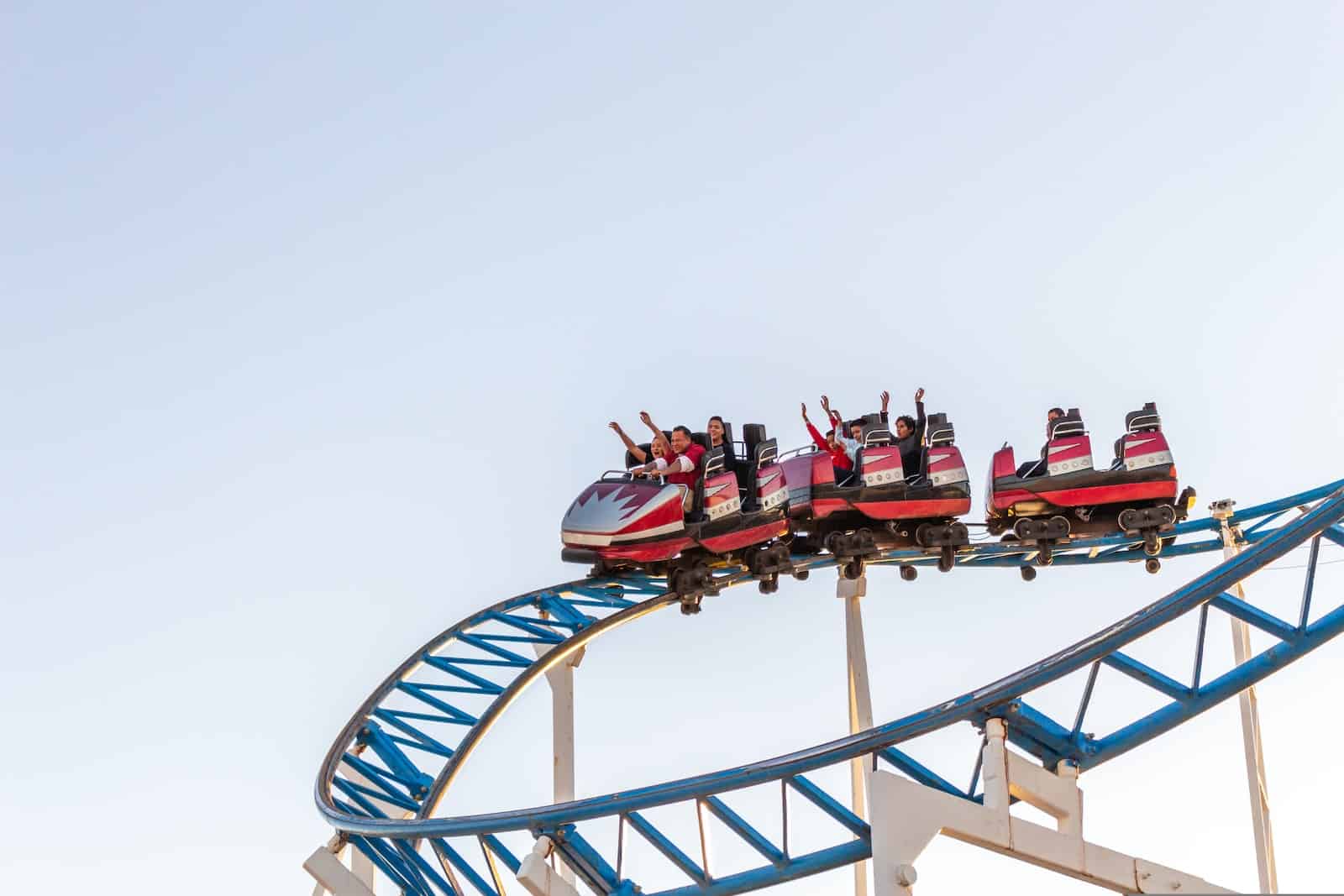
I can probably count on one hand the number of times I’ve been on a roller coaster in my lifetime. But these rides always struck me as being one of those things in life that most people have a definitive feeling towards.
As in, you either enjoy roller coasters or you don’t.
At least, doesn’t it seem that way from those photos that the amusement park has ready for you to buy on your way off the ride?
Roller coaster people are the ones with their hands in the air, smiles on their faces, and are screaming, woo-hoo-ing, and look excited.
Non-roller coaster people (that would be me) are the ones whose hands are firmly attached to the seat belt/bar/anything with a death grip, have tension etched on their faces with their eyes screaming fear, and are trying valiantly to calm themselves down and keep from freaking out the whole time.
Of course, if you’ve ever tried to calm down in situations like this, you know it’s pretty much an exercise in futility…
And what does this have to do with music?
Well, we tend to assume that learning how to calm down is the best way to deal with performance anxiety. But in fact, trying to calm down before a stressful performance may not only be similarly futile – but counterproductive to boot!
Wait – how’s that now?
Anxiety isn’t necessarily what we think it is
Think back to a time when you felt nervous about a high-pressure situation of some kind.
Maybe it was an upcoming performance, or a time you were going to have to give a speech, or take an important test. Do you remember how it felt?
Often, the anxiety starts with something small. Maybe your heart starts beating a little faster. Or you feel those butterflies in your tummy. You know this is all normal, but that doesn’t make you feel any better, and you might start to worry that this is going to derail your performance.
Which makes your heart beat even faster, which leads your thoughts to start spinning off to the bad place, which makes you feel even more nervous, and accelerates this negative spiral of doom.
We usually refer to this experience as “anxiety,” but technically, that’s not entirely accurate, because anxiety consists of separate physical and mental elements. And each affects performance differently.
How so?
Physical activation is not the same as anxiety
By itself, the heightened physiological fight-or-flight state we experience in performance settings is known as “arousal” or “activation.”
Our instinct is to try to calm ourselves down and take this high-energy state out of the equation. But the state of being physically activated is actually neither positive or negative.
It’s the mental and emotional experience – the worries, the fears, the doubts – on top of our arousal state that makes the overall experience either positive or negative, helpful or hurtful.
The subtle difference between anxiety and excitement
For instance, when you combine a heightened state of physical activation with negative emotion, you get anxiety. Which feels unpleasant and distressing.
But when you combine the same heightened state of physical activation with positive emotion, you get excitement. Which might include the same increase in heart rate, physical jitteriness, sweats and more, but feels much more positive.
And the reason why it’s important to make this distinction between the physical and the mental, and between anxiety and excitement, is that this matters a great deal when it comes to performing optimally under pressure.
Three studies, in different areas of performance
In a series of studies (2014), Harvard researcher Alison Wood Brooks set out to see if we might actually perform better under pressure if we didn’t try so hard to calm down.
And how would this work exactly?
Singing performance anxiety
In one study, participants were asked to sing the Journey song Don’t Stop Believin’ on a karaoke program, in front of an observer, where they could win some money, depending on their singing accuracy score (volume, pitch, and note duration).
Participants were split into three groups, and before singing, two groups were asked “How are you feeling?”
One group was told in advance to respond to this question by saying “I am anxious.”
Another group was instructed to respond by saying “I am excited.”
And the third group wasn’t asked how they were feeling at all.
And was there any difference in singing performance between the three groups?
Singing performance when “excited”
Indeed there was!
Singing accuracy was highest in the excited group (80.52%) and lowest in the anxious group (52.98%).
Which was actually significantly worse than the group which wasn’t asked about their feelings at all (69.27%).
Public speaking anxiety
Brooks also tried this “I’m excited” strategy with public speaking, but with a slight twist.
In this study, participants were asked to prepare a 2-3 min speech on a specific topic, which was to be delivered on camera, and later judged by a panel of their peers.
As in the singing study, some of the participants were asked to say “I am excited” before giving their speech. But others were asked to say “I am calm” before delivering their speech.
A 3-person panel then viewed the speeches, and scored the participants on a variety of factors.
And was there any difference between the excited and calm groups?
Public speaking performance when “excited”
Once again, there was!
The excited group was rated as being more persuasive, more competent, more confident, and more persistent than the calm group. Interestingly, they also gave longer speeches – 35 seconds longer on average.
Math performance anxiety
In a third study, Brooks tested this out with a group of participants who were asked to solve a series of difficult math problems under time pressure.
One group was urged to “try to get excited.” Another group was encouraged to “try to remain calm.” And a third group was told nothing at all.
And was there any difference in performance here?
Math performance when “excited”
Yep, you guessed it.
Once again, the excited group scored the highest – with an average score of 45%. The calm group and the no-instructions group both scored significantly lower, at 36.75%.
Why does this help?
So why is it that saying “I’m excited” seems to lead to better performance than saying “I’m anxious” or trying to calm down?
Well, this seems to be related to the idea that the physical and mental aspects of nerves affect our performance differently (check out this article for a more detailed explanation of how and why that is).
My take is that interpreting the physical activation as “excitement” might help to reduce the cognitive or mental aspect of anxiety, and free us up to focus more of our attention on the music and the task at hand. Instead of engaging in all of the worries and doubts that would otherwise tend to occupy our thoughts.
Takeaways
So the next time you have a performance, and the fight-or-flight response starts to kick in, try to avoid saying things like “I’m so nervous!” And not because you’re trying to hide how you’re feeling or that there’s anything wrong with nerves, of course!
But more because there have undoubtedly been times when a performance started out with nerves, but ended with genuine excitement. And because even if you aren’t feeling as calm as you’d like right at that moment, it’s totally possible to embrace the energy and heightened focus that comes with the adrenaline.
Sure, there might be a little bit of anxiety involved, but there’s probably also a part of you that’s feeling some excitement too. So embrace this part, even if you’re not sure if it’s there, and see what happens when you say “I’m excited” to yourself. Think of it as your new pre-performance mantra. 😁
References
Brooks, A. W. (2014). Get excited: Reappraising pre-performance anxiety as excitement. Journal of Experimental Psychology: General, 143(3), 1144–1158. https://doi.org/10.1037/a0035325


This confirms something I’ve wondered about for a while. I used to be a ‘keep calm’ type and I suffered from crippling performance nerves. Then somewhere along the way I started to tell myself I was excited rather than nervous and instantly performing became a pleasurable experience, and I felt in control. It’s interesting that you mention rollercoasters, because this change in my attitude coincided with moving to live near a theme park and overcoming my fear of going on rides and rollercoasters. I’d never linked the two together before 🙂
I have an audition coming up soon, and auditions have a way of melting me into a puddle of anxiety way before I even play, so I have been trying to figure out how to increase my performance during auditions.
Someone told me that one of the main reasons musicians mess up during performances such as these is because of the rush of adrenaline that comes due to activation, which increases heart rate, which increases jitteriness, which affects performing, and so on and so forth.
They told me a good method to increase performance level is to run up and down a flight of stairs 3 times (bringing your heart rate to about the level it gets right before a performance) and then practice. Apparently, this would allow you to become used to such conditions while playing so that you wouldn’t be affected when the actual performance came around.
What I would like to know is, is this an accurate method? Or should I be doing something else? Thanks.
Hi Jenae,
There are lots of reasons why we mess up in performances, but yes, some of it is indirectly related to the effect of adrenaline. Meaning, when our heart rate goes up, and we start feeling more jittery, we start worrying that we won’t be able to play our best, and so we get even more nervous and have difficulty focusing and concentrating on the right things. This loss of focus is what tends to be what derails our performance. Because you can have a heightened physiological state and still play your best. In fact, you’re probably not going to play your best unless you are in such a state.
So yes, learning how to perform with an elevated heart rate is helpful because after a while, you won’t be so easily distracted or disturbed by it. The other thing, of course, is that it means you’re doing more performance practice, which is helpful in and of itself.
I love this idea…It so happens that the rehearsal room at the moment is on the 6th floor, so I think I might run some experiments on this 🙂
What a wonderful way to conduct one’s life. “I am excited.”
Very timely as I had started to realise that trying to calm
myself worked a bit but what if the nervousness, etc could be
channeled in a positive way to enhance the performance. I hadn’t
yet figured out a way to do this. I will try the “I’m excited”
approach next time. Re the running up the stairs, before my last
public performance I practiced my songs while having the TV
blasting out in the same room. I found this, eventually, helped
greatly in focusing my concentration on what I was doing.
Thanks for the sage advice. I think this would work for
exams as well. I wonder if there is an element of “taking control”
when one says “I’m excited!” rather than succumbing to feeling
anxious. Nevertheless, I had a situation in which I was forced to
take a big-stakes exam for which I wasn’t prepared. I suspect that
is why the anxiety just wouldn’t go away–for months at a time. Not
a healthy situation! In that case, it would have been wise to pull
out of the program all together but I didn’t know that at the time.
Fortunately, I was able to transfer to another program of study.
When a door closes, another might open somewhere else!
I have no clue if I’m a rollercoaster person. Well, I LOVED them as a youngster (my neck and back doesn’t allow me to go on them anymore), but … whether my adrenaline is nerves or excitement seems to be context-dependent. If I’m in front of a gigantic crowd with a microphone, I’m definitely excited. I’m one of the freakiest of freaky living creatures in that I LOVE public speaking — the more extemporaneous the better. I adore it.
Stick a piano in front of me, and I turn into a puddle of anxiety, screw up, and slink offstage in misery.
I guess it depends on the rollercoaster. I’ve never been able to figure out what’s up with that. I think it’s a matter of the audience not knowing what I’m going to say; I can direct everything, choose my own words, create the universe I want to create up there. I’m not lashed to the mast of someone else’s ideas. If I were an improviser, I would probably be much more relaxed on stage.
same problem! I’m great when I make an oral…but performing on the piano kills me.
niice article! I thought the exact same thing. weird as it can be, I got the tip of changing nervosity to excitement by this Amy Winehouse interview https://www.youtube.com/watch?v=5VPc0PLiRNI (11min10 to 11min35)
The interviewer is asking her “well don’t you get nervous or shy on stage?” and she keeps on repeating “no! it’s exciting!” even though she’s an insecure person. since this video I decided to change my view of fright and nervosity to excitement.
I didn’t try it yet, but since I am really anxious on stage and often mess up my public performances, i’ll let you know if it works better!
[…] What Leads to Better Performances: Telling Yourself to Calm Down? Or Get Excited? (Bulletproof Musician) – How to manage your emotions to boost your stage presence. […]
I do my best playing when I’m in a state of “flow”. start out fine in rehearsals because my mind is engaged with playing the notes and taking direction from the conductor. As we get more familiar, thoughts creep in about how bad it would be to miss the next note. Then I start missing notes. I can’t quiet my mind and get back into that “flow”. I need help!
Paloma I just read about that yesterday. Here’s the link- it’s a pdf you can download.
http://web.uniarts.fi/practicingtipsformusicians/articles/the-flow-of-music.pdf
Thanks for the advices Noa. My problem is that when I am excited, I Sometimes rush during and I am feeling good but the jury does not like me to rush. And sometimes also with exciting mood, although I do more nuances, I also do more mistakes. That why I also need to be calm or excited but not to much…
Hi Lise – yes it can be easy for rushing/etc. to happen when we get too excited. One thing that can help with security when excited and doing more nuances, is to make sure to practice more extreme nuances well in advance, so that this is something that is baked into your technique before encountering a pressure situation.