


I remember having a lesson one summer with Paul Kantor, where he said something about how the little dots and lines and symbols on the page of music in front of me were an imperfect system for communicating what the composer had in mind.
I nodded thoughtfully at the time, though I don’t think I truly understood what this meant 😅. But when I took a music technology class a couple years later and began exporting and playing MIDI files, I realized what he had been trying to tell me. When followed too literally, without an effort to read between the lines and use the clues that the composer has left us, the result is not really music, but just a soulless sequence of sounds.
Which isn’t much fun to listen to – and is not an especially fun way to play, either.
So is playing more expressively something that can be taught? And if so, how?
A study!
Curious to explore the effectiveness of three strategies that teachers often utilize to enhance the expressiveness of a student’s playing (more on what these are in a moment), music education researcher Robert Woody (2006) recruited 36 undergraduate and graduate pianists to participate in a comparison study.
Half of the participants were more advanced players and considered piano to be their primary instrument. They had had an average of ~17 years of private lessons, and practiced about 11 hours per week.
The other half were certainly competent players, but less advanced, as piano was not their primary instrument. They averaged about 9 years of private lessons, and spent about 3 hours per week practicing.
Three melodies
Three short melodies were selected for this comparison. One was composed for a previous experiment, and the others were taken from two Schubert song cycles1.
Students were presented with the three melodies, and given a chance to practice and get comfortable with the short excerpts of music.
And when ready, they recorded a performance of the melodies, while instructed to play them in a “normal musical way, without doing anything special.”
Three types of instruction
Then, it was time to practice each melody again, but with instructions on how to play the melodies more expressively.
Some of the students reworked the first melody with the help of an auditory model and a basic notation of the music (example below). An aspirational version of the melody recorded by one of the faculty members. They were allowed to listen to the model and practice on their own as much as they liked, after which they recorded the passage once again.

Other students reworked the first melody with the help of concrete musical instructions instead. Where the music included specific cues and instructions provided on what to do with the passage to make it sound more expressive (example below). Like dynamics, hairpins, accents, dots, phrase markings, and instructions on how and where to vary the tempo and by how much. Here too, the students were allowed to practice the passage as much as they wanted, before recording it once more.

And then there was a group of students who reworked the first melody in light of a mental imagery prompt – a verbal description of a character or mood or emotion that provided an expressive target for the passage. Like, “Play with sadness and intensity as you would when expressing the loss of a loved one. There’s the bittersweet remembrance of great tenderness and great loss.” Or, in this case, “Bouncy and happy. Rustic, as if you’re a happy peasant, with no cares or worries, strolling along, singing a song.”
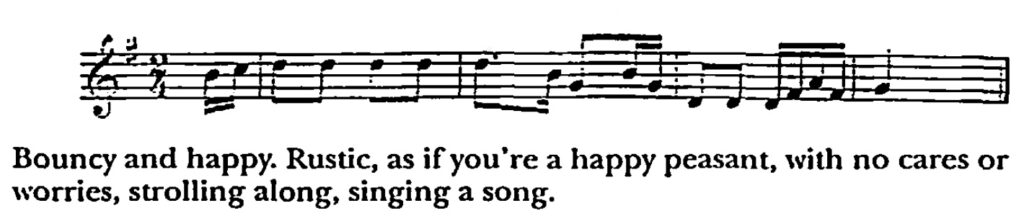
And then they each cycled through the other two passages, using the types of expressive instructions they hadn’t yet tried.
So which type of instruction led to the most change in expressiveness?
Results
The short answer is…all of the above – sort of!
All three types of instructions helped to bring about positive changes in expressiveness. And there wasn’t one that was necessarily “better” than the others overall. However, there were nuanced differences and advantages and disadvantages of each.
Let’s take the third passage, for instance.
Looking specifically at tempo, aural modeling contributed to the biggest change, with students in this condition playing the passage much faster in their final performance. Meanwhile, those in the mental imagery condition played it only slightly faster than they did in their first performance. And those who received the concrete musical instructionsactually played it slower on average than they did in their first performance!
In general, here’s what Woody found:
- Aural modeling seemed to help students get closer to the expert model. However, it could be easy to simply replicate the model, instead of using the model to inspire your own interpretative ideas.
- Concrete musical instruction seems to help produce a more expert-level expressive performance, but it tends to require more repetition and time to get there. When relying on musical instruction to enhance the expressiveness of their playing, the participants did an average of 4.8 run-throughs of the passage before recording it, whereas in the aural model and mental imagery conditions, students did only 3.3 run-throughs before making their recordings.
- Mental imagery was also quite helpful in facilitating more expressive performances, and led to “considerable” changes in many cases. However, the changes weren’t necessarily always musically appropriate or aligned with the score and the composer’s presumed intention.
So what are we to do with all of this?
Takeaways
Well, this is where a teacher’s knowledge of both the music and the individual student and their level, goals, needs, and circumstances is so important.
As Woody explains, there are times when an aural model may be most effective. For instance, when trying to help a student really hear and produce a particular type of sound (as flutist Keith Underwood describes doing with recordings here).
Or, if a student’s performance lacks expression or doesn’t quite communicate the right mood or character, the mental imagery strategy could be just the thing to inspire a change (as horn player Julie Landsman describes in her podcast episode here).
And if there is just a little fine-tuning required, concrete musical instructions could help to pinpoint those last few details or subtle nuances needed to elevate the student’s playing to that special place.
One additional detail
And was there any difference in how the advanced and less-advanced students too to these instructions?
One of the cool details in the study was the observation that these expressive instructions helped the less-advanced students “close the gap” expressively with the more advanced students from their first recording to their last recording.
There are some important nuances to keep in mind of course – for instance, this “closing the gap” phenomenon was true for the most important musical aspect of each melody, but not as much so for the less-prominent musical elements. Also, it’s not clear from this study alone how well these strategies might work with much less experienced or younger students.
But if you’re searching for ways to help students play more expressively, in light of last week’s article which looked at the connection between expressive playing and flow states (The Overlooked Skill That Could Make Performing More Enjoyable), these three strategies could be a good place to begin!
References
Woody, R. H. (2006). The effect of various instructional conditions on expressive music performance. Journal of Research in Music Education, 54(1), 21–36. https://doi.org/10.1177/002242940605400103


“Be more expressive.” “That’s not the composer’s intent.”
Then the teacher plays their intent or expression, which might not be what the student hears or feels.
Odds are, the student doesn’t have much expression or their feelings about the music because they’ve been taught to play to a narrow standard and be a clone of what is considered the “way” to play Bach, Beethoven, etc…
The only person who knows how a composition sounds is the composer, and not every composer might want much of anything changed in their work.
All of this to say that in “classical” music, it seems very odd to me that you spend a large chunk of your life trying to play to one extremely narrow interpretation of excerpts, and composers’ intents, with nobody ever asking you for your interpretations, and then turn around and tell someone to play more exprsessivly? For years we suck any individuality out of the performer and then ask them to add an individuality that is wrote or what someone else has determined is the appropriate expression.
This all seems very strange to me.